Most Comfortable Bike Seat for Long Rides: How to Choose (2026)
The most comfortable bike seat for long rides is not the softest one. It is the saddle that supports your sit bones at the right width, matches how upright you sit, and keeps pressure off soft tissue for hours. Get those three things right, add a good chamois, and a 60 km ride stops being a test of endurance for your backside. This guide shows you how to choose, with a quick-pick table if you are in a hurry.
Quick answer: which saddle for which rider?
| How you ride | Your position | What to look for | Our pick |
|---|---|---|---|
| Road rides, long fast days | Stretched, leaning forward | Medium width, supportive (not mushy) padding, pressure relief | CycloSport™ or VeloxSeat™ |
| Fitness, hybrid, gravel touring | Semi-upright | Medium-wide, memory foam, shock absorption | CycloSoft™ |
| City bike, e-bike, cruiser | Upright | Wide seat, thick padding, shock absorption | MaxiComfort™ or UrbanSoft™ |
| Daily commute in all weather | Upright | Soft silicone, non-slip, rain-proof | SiliconRide™ |
Not sure where you fit? Read on: the four steps below take five minutes and save you from buying the wrong saddle twice.
Why your saddle hurts after an hour
Almost all saddle pain on long rides comes from one of four problems:
- Wrong width. If the saddle is narrower than your sit bones, your weight lands on soft tissue instead of bone. That is the classic "numb" feeling.
- Wrong shape for your position. The more you lean forward, the more your pelvis rotates and the more pressure moves to the front of the saddle.
- Padding that is too soft. Very soft foam feels great in the shop, then you sink into it, it presses into the areas you want to protect, and friction goes up.
- Friction and moisture. Seams, cotton underwear and sweat cause chafing and, eventually, saddle sores. See how to prevent saddle sores.
Step 1: measure your sit bones
Your sit bones (ischial tuberosities) are the two bony points you feel when you sit on a hard chair. The distance between them decides your saddle width far more than your weight or size does.
- Put a piece of corrugated cardboard or a folded sheet of aluminium foil on a hard, low stool.
- Sit on it, lift your feet and lean forward slightly, as you would on your bike, for 30 seconds.
- Stand up and measure the distance between the centres of the two dents.
As a rule of thumb, add about 20 to 30 mm to that number for a road position, and more for an upright position, where almost all your weight sits on the saddle. Most adults measure between 100 and 140 mm.
Step 2: match the shape to your riding position
Leaning forward (road, gravel, fast fitness rides)
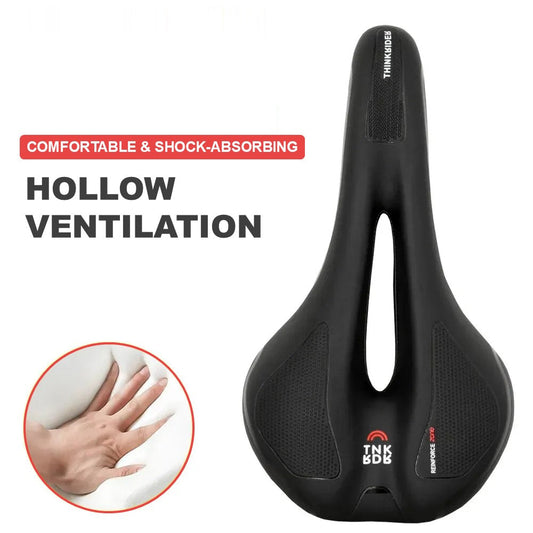
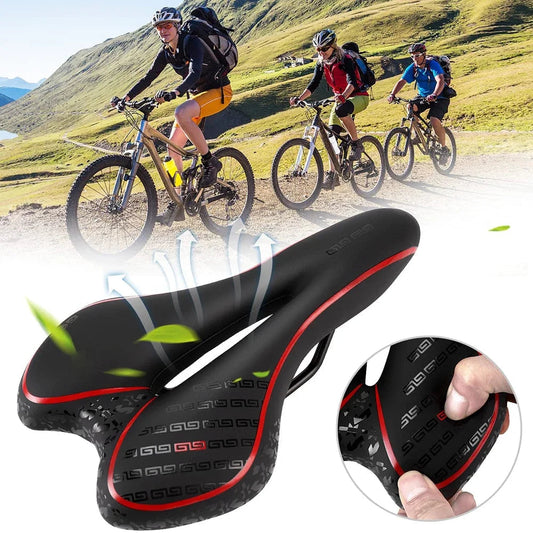
You need a saddle that is narrow enough at the front not to rub your thighs as you pedal, with support at the back for your sit bones and a relief zone in the middle. Sport saddles such as CycloSport™ and VeloxSeat™ are built for this: ergonomic padding, pressure relief and ventilation without the bulk of a city seat.
Semi-upright (hybrids, trekking, touring)
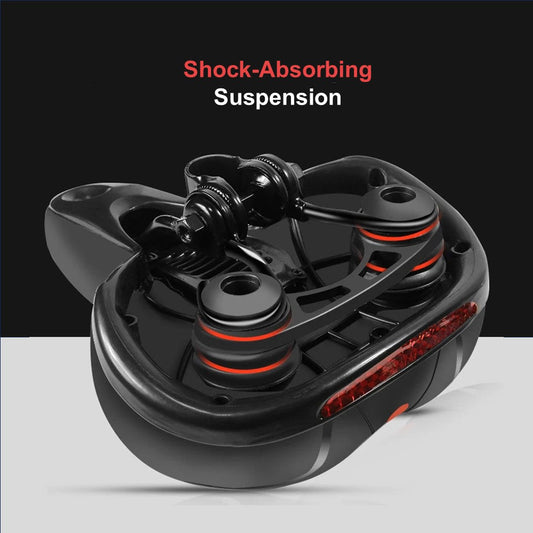
Your hands carry less weight, so the saddle carries more. Go a little wider with medium padding. CycloSoft™ uses memory foam that moulds to your shape and a shock-absorbing base, a good all-rounder for long days.
Upright (city bikes, e-bikes, cruisers)
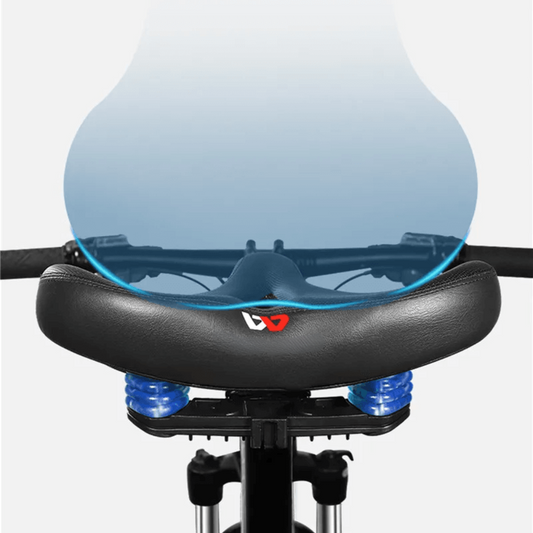
Here nearly all your body weight is on the saddle and you barely move on it. A wide, well-cushioned seat with shock absorption is the right call. MaxiComfort™ is our widest memory-foam saddle, and UrbanSoft™ is a lighter, waterproof option for daily city riding.
Step 3: choose the right padding
- Firm foam: the choice of road riders. It does not feel plush, but it holds its shape over 4 or 5 hours, as long as you wear a chamois.
- Memory foam: moulds to your body and spreads pressure evenly. A great middle ground for long rides at moderate speed.
- Gel: excellent at absorbing vibration and repeated bumps. Best on wider saddles and rougher roads.
- Silicone: very soft, non-slip and unaffected by rain. Ideal for commuters who park outside.
The key point for long rides: padding works best in layers. A supportive saddle plus a padded liner or shorts beats one very thick saddle, because the chamois moves with you and also stops friction. More on that below.
Step 4: set it up properly (this fixes half of all saddle pain)
- Height: with your heel on the pedal at the bottom of the stroke, your leg should be straight. Too high and your hips rock, which causes friction; too low and you put more weight on the saddle.
- Tilt: start perfectly level. If you feel pressure at the front, tip the nose down by 1 or 2 degrees at most. Too much tilt pushes you forward and loads your hands.
- Fore and aft: slide the saddle so your knee sits roughly above the pedal axle when the cranks are horizontal.
- Give it time: allow 2 to 3 weeks and a few hundred kilometres before judging a new saddle, and change one thing at a time.
The comfort combo: saddle + padded underwear
Even the best saddle cannot stop friction from seams and sweat. That is the job of a chamois. If you do not ride in Lycra, a pair of padded cycling underwear under your normal shorts gives you a 5D gel pad that sits exactly between your sit bones and the saddle. Riders who switch usually notice the difference on the very first long ride.
Want to understand the difference between pads? Read gel vs foam padding and our complete guide to padded cycling underwear.
Signs your saddle is wrong for you
- Numbness or tingling in the groin area after 30 to 60 minutes.
- You constantly shift forward or backward to find a comfortable spot.
- Pain on one side only (often a sign of saddle height or a leg length difference).
- Chafing on the inner thighs: the nose may be too wide for your position.
- Sore hands and wrists: the saddle may be tilted too far nose-down.
Our comfort saddles at a glance
- CycloSoft™: memory foam, shock absorption, non-slip surface. The all-rounder for long rides and commutes.
- MaxiComfort™: extra-wide memory foam with shock absorption, for upright riders who want maximum support.
- CycloSport™: sport shape with ergonomic padding and a breathable design, for road riders.
- VeloxSeat™: sport-comfort saddle with pressure relief, ventilation and a waterproof cover.
- SiliconRide™: ultra-soft silicone, non-slip, comfortable in any weather.
- UrbanSoft™: light, waterproof and breathable, made for daily city riding.
All ship free with a 30-day money-back guarantee. Compare our comfort saddles.
Frequently asked questions
Is a wider saddle always more comfortable?
No. A wide saddle is more comfortable when you sit upright. In a forward road position, a very wide nose rubs your inner thighs and causes chafing. Match the width to your sit bones and your position.
Are gel seat covers worth it?
A gel cover can help on a short commute, but on long rides it tends to slide and adds friction. A properly shaped saddle plus a padded liner is a better long-term fix.
How long does it take to get used to a new saddle?
Usually 2 to 3 weeks of regular riding. Some tenderness on the sit bones at first is normal; numbness or sharp pain is not, and means the saddle or its setup needs changing.
Which saddle is best if my pelvis tilts forward?
Riders who rotate their pelvis forward (common in aggressive road positions or with anterior pelvic tilt) put more weight on the front of the saddle. Look for a pressure-relief zone in the centre and a nose that is not too wide, and check that the saddle is not tilted nose-up.
Can a better saddle help with lower back pain?
It can help if the pain comes from road shocks or from sliding around on the saddle: a shock-absorbing seat and a stable position reduce strain. Persistent back pain is usually a bike fit or health question, so get it checked.